
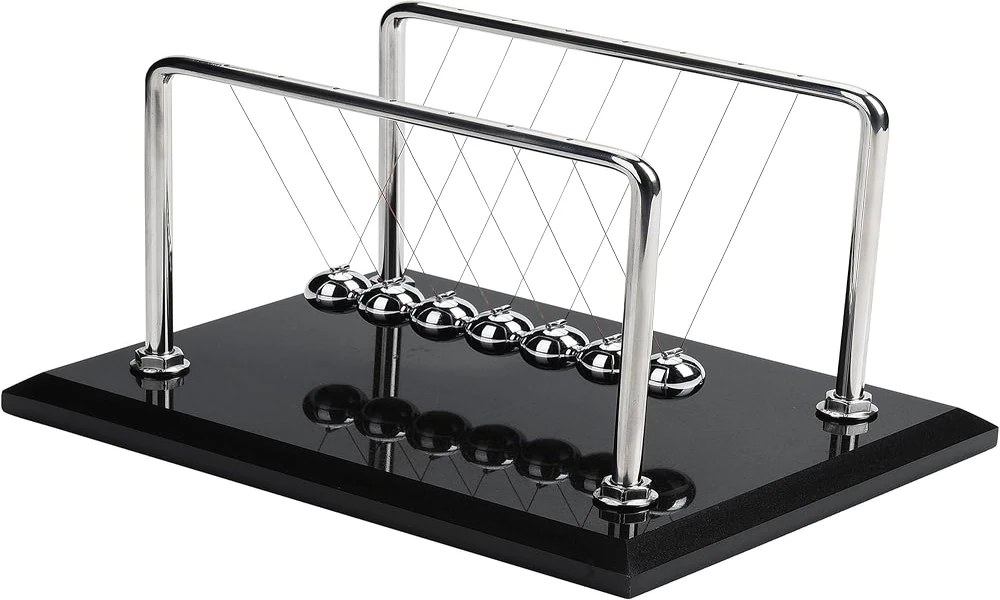

Designed for interactive STEM learning, the Newton’s Cradle simulator by Active Kinetic 1, turns complex physics equations into an easy-to-follow visual experiment. Students can test different drop combinations, from single-ball swings to multi-ball collisions, and switch seamlessly between momentum and kinetic energy telemetry to see the maths behind every movement.
A Newton’s cradle is an engaging way to explain kinetic energy transfer and the conversion between different forms of mechanical energy. Before the demonstration begins, a student lifts one of the suspended metal balls above its resting position. That action increases the ball’s gravitational potential energy. When the ball is released, gravity accelerates it downward, converting much of that stored energy into kinetic energy as it approaches the other spheres.
At impact, energy does not simply jump magically from the first ball to the last. The balls undergo tiny elastic deformations, storing energy momentarily within their materials while contact forces transmit an impulse through the row. In an idealised Newton’s cradle, the departing sphere carries approximately the kinetic energy that the incoming sphere possessed immediately before collision. In an actual apparatus, the transfer is less than perfect, but the outgoing motion remains a compelling demonstration.
This makes the device useful for introducing the difference between energy conservation and energy dissipation. Total energy is conserved, yet the visible mechanical motion fades because some of its energy becomes sound, heat and vibrations, with further losses from air resistance and friction at the suspension. Students can listen to the clicking impacts, observe the gradual reduction in swing height and discuss where the original mechanical energy has gone.
Teachers can extend the activity by comparing different release heights, estimating changes in gravitational potential energy, or using video to track the swinging balls. These investigations support lessons on work, velocity, elastic collisions and mechanical efficiency. This progression gives students a practical foundation for understanding energy exchanges in machines, sports equipment and other moving objects. The Newton’s cradle simulator tool is effective precisely because it links a familiar physical action, lifting and releasing a ball, to a broader scientific account of how energy is stored, transferred and transformed.
To deepen understanding, the Newton’s cradle simulator tool lets users compare frictionless Simple Harmonic Motion with real-world mechanical decay, clearly illustrating how sound and heat reduce energy retention over time. It also features a dedicated Paradox mode that visually proves why one ball cannot eject two balls at half speed, making it a practical, embeddable teaching aid for classrooms and science websites.
Newton’s Cradle Simulator
Compare classical mechanical sphere impacts with parallel-face Active Magnetic Cradle (AMC) dipole carriages.
Newton’s Cradle for STEM education
